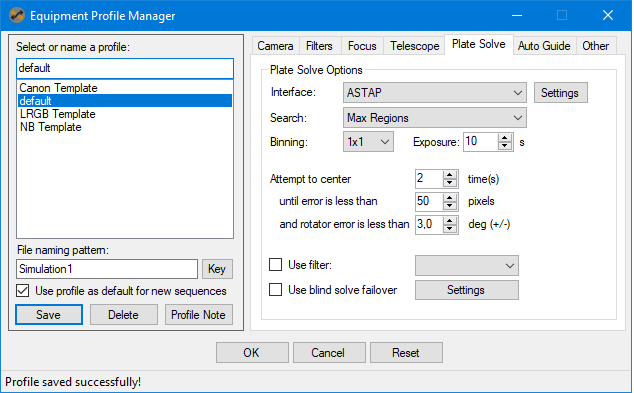
10 seconds is a good starting point but it can work down to 1 second. ASTAP requires requires about 30 visible stars for reliable detection. If your using a h-alpha filter or any other small band filter in some cases 20 seconds required. If it fails, in most cases just increase the exposure time. If M13 fills most of the image, you have to reduce the exposure time as indicated in this forum.
The search regions setting indicates how may areas/regions it will search around the initial RA, DEC position. For ASTAP you can set this at max regions. It will search then up to maybe 90 degrees from the start point in less then a minute before a timeout stops it. So it will work effective as a blind solver. (search regions is a setting from PlateSolve2 and since ASTAP is operated in PlateSolve2 mode reused. In the long term the ASTAP native mode should be used by SGP)
Binning can be set at 2x2 if your image are 4000x3000 pixels or higher or if you have a colour camera. . If your image resolution is less you better set is at 1x1. If you don’t know just set it at 1x1, then ASTAP will bin it automatically. A too high binning value will result in failure. Too low binning not, but maybe a little slower.
There is no need for a blind solver unless you find it unreliable and want a backup solver. Depending on your FOV, ASTAP will search half of the sky in a minute or so. Easiest would be configure the online version of Astrometry.net as backup since it doesn’t required installation
I would suggest to test SGP & ASTAP with saved images so your well prepared for the next clear sky moment.
FOV setting is important. Try to set the camera pixel scale in "/px correct within 5%. If you don’t know, upload an image to nova.astrometry.net
Han
author of ASTAP.